
Blog
Which FEFCO Box Style Do You Need? Guide by Job
FEFCO box styles compared by the job they do: shipping cartons, e-commerce mailers, bottle boxes, trays and pizza boxes, with the code to ask for.
Published
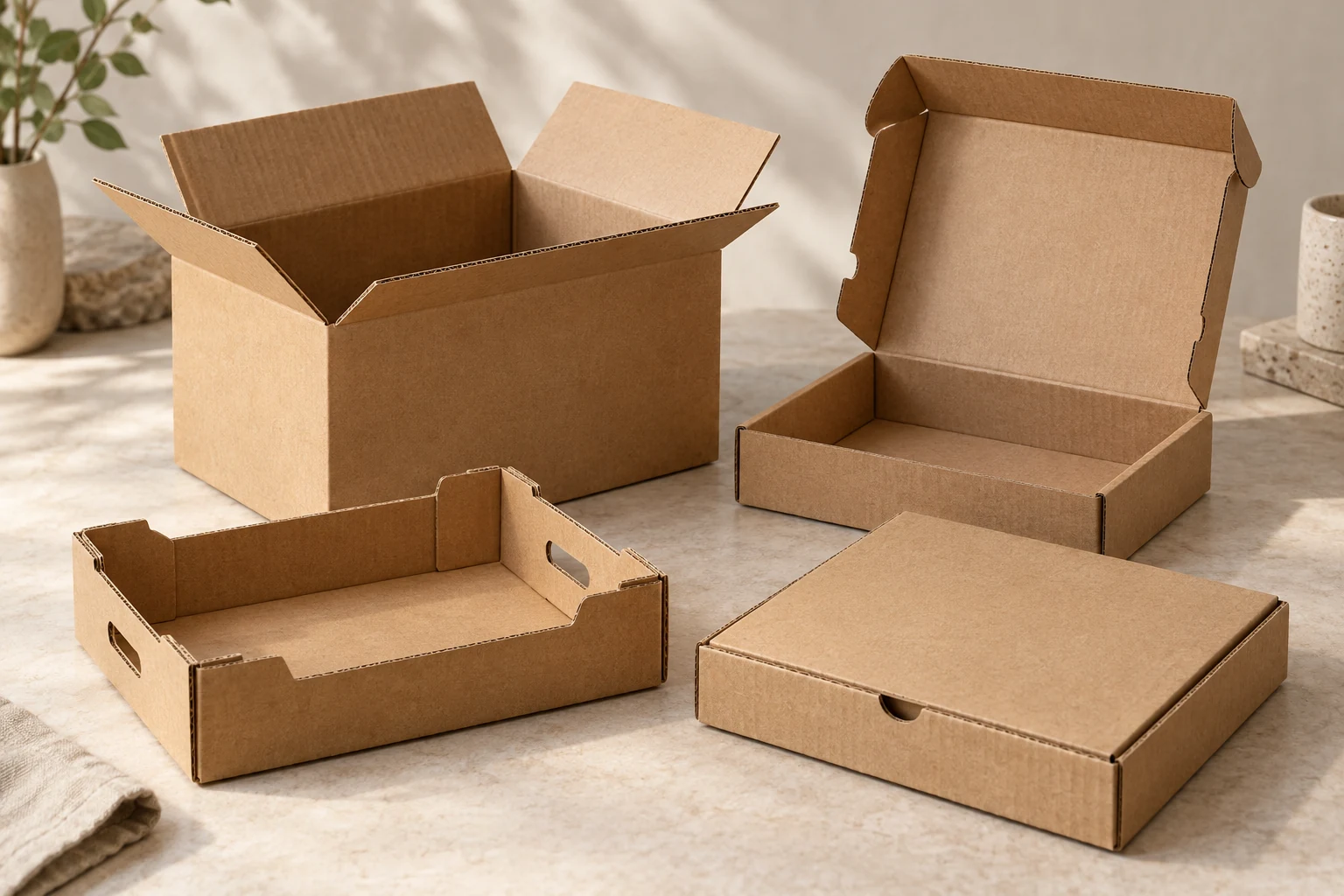
People who look up FEFCO styles usually want one of two things: they have a code on a quotation and want to know what it is, or they have a product and want to know which code to ask for. The FEFCO code guide covers the first case digit by digit. This one is for the second. It groups the common corrugated styles by the job they do, says what each one trades off, and links to a parametric template you can open with your own dimensions.
A FEFCO code names a construction, not a size or a board. Two converters reading "0201" will draw the same blank; what still has to be agreed is the internal dimensions, the flute and the board grade. Keep that in mind as you pick.
Shipping cartons that travel in a courier network
The 02 series holds the slotted boxes: one-piece blanks joined with a glued, stitched or taped manufacturer's joint and closed by flaps at top and bottom. They ship flat, erect quickly and run on standard case-making equipment, which is why most shipping cartons are one of these.
| Job | Code | Why this one |
|---|---|---|
| The default shipping carton | FEFCO 0201 | Regular slotted container. All flaps the same depth, outer flaps meet at the centre. The most board-efficient closed box there is. |
| Heavy or stacked loads | FEFCO 0203 | Full overlap. The outer flaps cover the whole top and bottom, so the ends carry double thickness and resist crushing and rough handling. |
| A flat, even top for print or a label | FEFCO 0204 | Centre special slotted. Inner and outer flaps both meet at the centre, giving a level surface and a double layer across the whole face. |
| Extra sealing on the top | FEFCO 0202 | Overlap slotted. The outer flaps overlap by a set amount, so the closure is stronger and easier to tape than a butt joint. |
| An open-top bin or a telescoping tray | FEFCO 0200 | Half slotted. Flaps on the bottom only. Used for storage bins and, with a matching cap, as the body of a telescope box. |
Start with 0201. Move to 0203 when the product is heavy or the pallet is tall, to 0204 when the top face matters for presentation, and to 0200 when the box is never closed.
E-commerce mailers that open in front of the customer
A mailer has a different brief: it is handled by machines in transit but opened by a person who then sees the inside. The styles in this group are die-cut rather than slotted, fold without glue or tape, and present a clean interior.
| Job | Code | Why this one |
|---|---|---|
| The classic die-cut mailer | FEFCO 0426 | Self-locking tray with a hinged lid. Locks closed without tape, lies flat before use and opens like a lid. The workhorse of subscription and apparel shipping. |
| A mailer with locking ears | FEFCO 0427 | The 0426 family with ears that lock the side walls, used from produce trays to retail mailers where the walls take more strain. |
| A hinged-lid tray for lighter goods | FEFCO 0441 | Tray with hinged lid. Less board than a 0426 for the same footprint, suited to flat or soft products. |
| Books and flat items | FEFCO 0420 | One-piece folder. The blank wraps the product and adjusts to its thickness, so one size covers a range of page counts. |
| A small tuck-end mailer | FEFCO 0210 or 0211 | Straight or reverse tuck end in corrugated. Fast to pack by hand. On 0211 the top and bottom tucks open from opposite faces, so the box can be filled from one side and closed from the other. |
| A mailer that must not spill when lifted | FEFCO 0215 or 0216 | Snap-lock base under a tuck top or a slotted top. The base locks before loading, so it holds weight without tape. |
| A box that collapses for return or reuse | FEFCO 0759 | Ready-glued, collapsible hinged-lid box from the 07 series. Arrives flat, pops open, folds flat again. |
For most online retailers the decision is between 0426 and a snap-lock base style. Pick 0426 when unboxing matters and the product is light enough for a lid that only locks; pick 0215 or 0216 when the packer loads from the top and the base has to hold on its own.
Bottles, jars and anything that must not touch its neighbour
Glass and rigid containers need separation. The six-cell slotted styles build the dividers into the blank so there is no loose insert to pack.
| Job | Code | Why this one |
|---|---|---|
| Six bottles or jars, regular slotted closure | FEFCO 0207 | Six-cell regular slotted. The cells are part of the blank; the top closes like a 0201. |
| Six bottles or jars, slotted variant | FEFCO 0208 | Six-cell slotted. The same partition idea with a different flap arrangement. |
Check the cell size against the container diameter including any label or sleeve, and agree the flute with your converter, because cushioning differs between flute profiles.
Trays, produce and food service
The 04 series folders and trays are die-cut, erect by hand and often stay open. The FEFCO family hub lists the self-locking tray variants (0431 to 0437) side by side; the two styles below cover most produce and food-service questions.
| Job | Code | Why this one |
|---|---|---|
| A greengrocer or produce tray | FEFCO 0427 | Self-locking tray with locking ears. Stacks, ventilates and erects without glue. |
| A pizza box | FEFCO 0426 pizza variant | The 0426 geometry proportioned for a flat, square product. |
What the code does not decide
Three things are outside the code and have to be written on the order:
- Internal dimensions. The template takes length, width and depth of the inside; the converter adds board thickness. Measure the packed product, not an existing box, as described in how to measure box dimensions.
- Board and flute. B, C, E flute or a double wall change the crush strength, the crease behaviour and the external size. The same 0201 dieline in E flute and in BC double wall are different boxes.
- Closure. Tape, glue, stitching or a self-lock. Some styles assume one; the slotted cartons leave it to you.
Try the style with your own numbers
Every code above links to a template. Open one, enter the internal dimensions, and read the blank it draws: flap depths, slot positions and the manufacturer's joint are all derived from your numbers. On the styles that support it, the 3D preview folds the same model so you can see the flaps close before anything is cut. The full set, including the variants not listed here, is at /templates/fefco, and if you are comparing with folding cartons the ECMA family sits next to it.