
ECMA · 2D DIELINE
Retail Product Box
ECMA A45.20.01.01
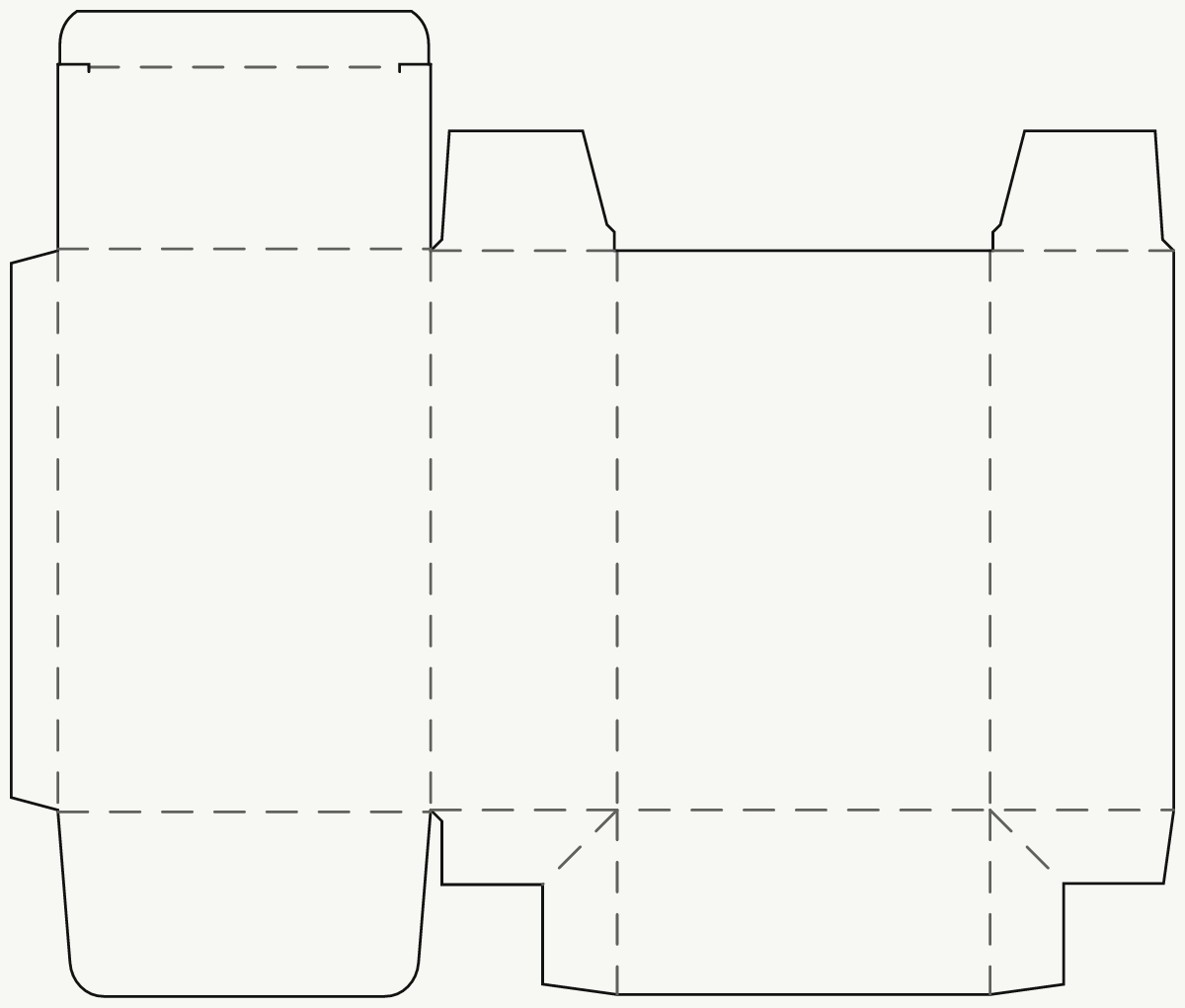
Tuck Top Joined Dust Flap Bottom Carton. A long-seam glued carton with a square flap with joined dust flaps at the base and a tuck flap that slides between the panels at the top.
Use this templateInteractive 3D folding is available in the studio.

Artwork shown for illustration. Add your own in the studio.
CONSTRUCTION NOTES
About this construction.
Reading the code A45.20.01.01
A45.20.01.01 sits in ECMA group A: long-seam-glued folding cartons with rectangular surfaces. The carton is glued into a sleeve along its long seam, and the code's panels are numbered 1 to 4 starting from that glue seam. The two leading blocks describe the closure systems — the bottom first (45), then the top (20); the following blocks record which panel each closure's flap is connected to.
Here the bottom end uses the joined dust flap closure (45), and the top end uses the tuck-in flap closure system (20).
Counting from the glue seam, the bottom flap hangs on panel 1 and the top flap hangs on panel 1.
How the closures behave
The two dust flaps are joined by a web across the corner, so the end has no gap at the corners once the closing flap is down. Dust, crumbs and fine product stay inside without a glued end.
A single flap folds over the end and its tuck slides between the panels — the everyday closure of retail cartons: quick to close by hand, clean on the shelf, and reopenable without damage.
Typical uses
Dust-tight ends serve dry foods and pharmacy packs where nothing may sift out or get in: tea bags, dried herbs, tablets in strips, sachets and loose small parts.
Tuck-closed cartons are the default retail carton: cosmetics, pharmaceuticals, small hardware and boxed goods that are filled by hand or at moderate line speeds and need to present cleanly on a shelf.
Dimensions and board
The parameters above — length, width, depth and paper thickness — drive the whole blank. Board caliper is not a footnote: tuck clearances, lock engagement and panel fit all scale with it, which is why it is a first-class input to the parametric model rather than an allowance you add by hand.
Every value is validated against the template's supported range, and the 2D dieline and 3D fold preview regenerate together from the same structure. Confirm final board grade, grain direction and tolerances with your converter before production.
Industries and applications
Converters cut the Retail Product Box (ECMA A45.20.01.01) for retail product boxes for the shelf, food and dry-goods cartons, and pharmacy cartons for medicines, blister packs and supplements.
Retail cartons live on a shelf: they must stand square, print well on every face and close again after a customer has looked inside.
COMMON QUESTIONS
Quick answers about this template.
What is Retail Product Box — Tuck Top, Joined Dust Flap Base?
ECMA A45.20.01.01 is a long-seam-glued folding carton in ECMA group A (base: joined dust flap closure; top: tuck-in flap closure system).
Which dimensions does the Retail Product Box — Tuck Top, Joined Dust Flap Base dieline need?
4 parameters drive the blank: L (length), W (width), D (depth), Paper thickness (mm, µm). Each value is validated against the template's supported range, and the whole dieline regenerates from them.
Can I see how Retail Product Box — Tuck Top, Joined Dust Flap Base folds before cutting it?
Yes. The interactive 3D fold preview and the 2D dieline are generated from the same parametric model, so the fold you watch on screen is the geometry of the sheet you cut. Open the template in the studio to fold it at your own dimensions; 3D folding comes with the Workshop and Line plans.