
ECMA · 2D DIELINE
Confectionery & Chocolate Box
ECMA B31.11.84.50.33
Self-Locking Tray with Lid and Tongue Lock. An unglued carton tray whose four webbed corners lock it without glue, with four dust flaps and an attached tuck lid. A front extension panel carries a tongue that enters a slot at the lid hinge and locks the lid shut. A single blank forms the tray and lid.
Use this templateInteractive 3D folding is available in the studio.
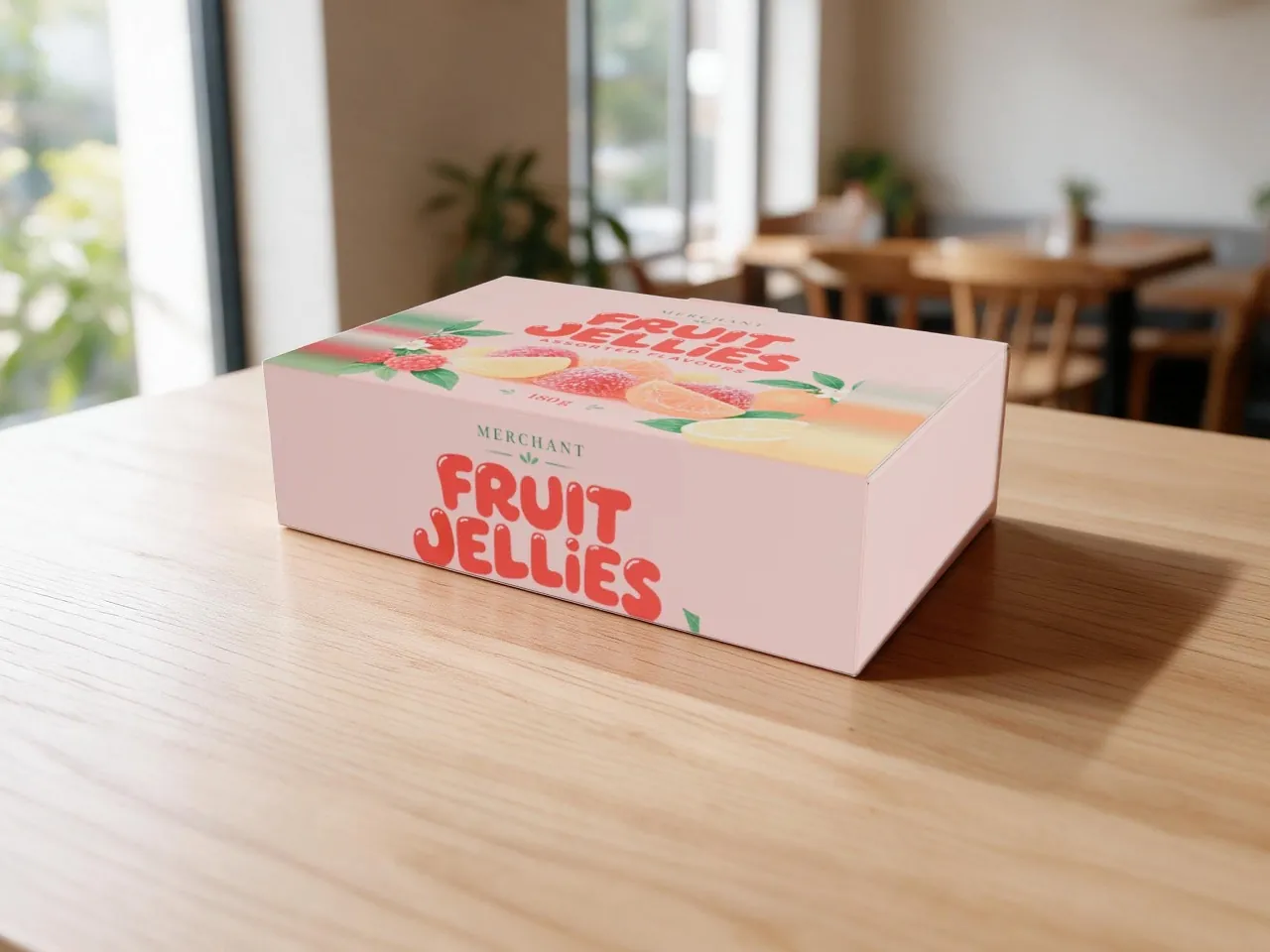
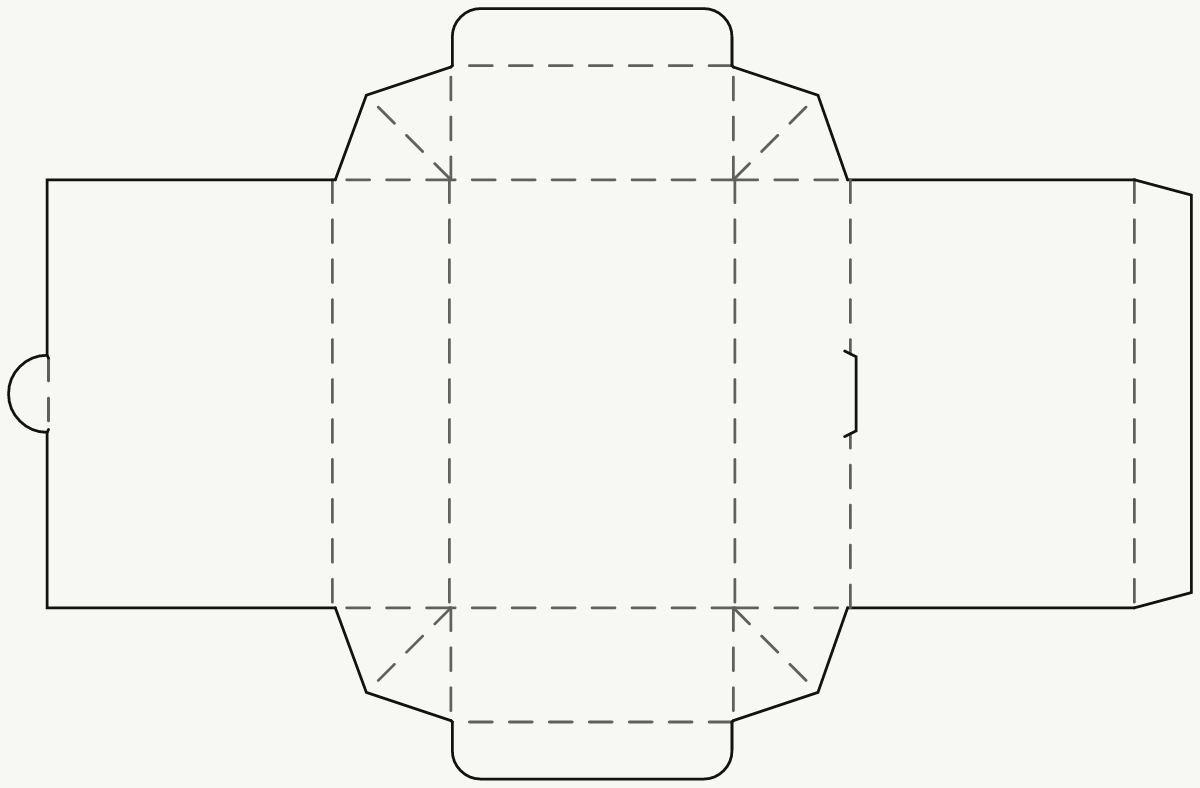
Artwork shown for illustration. Add your own in the studio.
CONSTRUCTION NOTES
About this construction.
Reading the code B31.11.84.50.33
B31.11.84.50.33 sits in ECMA group B: non-long-seam-glued folding cartons with rectangular surfaces — tray-style constructions that lock together without a glued long seam, with all outer panels meeting at right angles. The code's blocks describe, in order, the basic tray shape (31), the flap locking system (11), the dust flaps (84) and the cover system (50).
This design is an unglued self-locking tray with webbed corners, locked with webbed corners that lock the walls square, with 4 dust flaps, closed by a tuck-in flap cover.
Group B designs can serve as a single tray or, paired with a matching lid, as a telescopic packaging system.
The trailing .33 is an ECMA group X feature code recorded with this design.
How the closures behave
The tray erects like the B31.11.84.50: webbed corners fold inward and lock the walls square, and four dust flaps sit under the lid. The .33 feature adds a front extension panel whose tongue enters a slot at the lid hinge, so the closed lid is held at the back as well as by its tuck at the front.
Typical uses
Unglued tray constructions are erected at the point of use without adhesive: food and bakery trays, counter and display trays, and — with a lid — telescoping gift and presentation boxes. Because they lock by geometry, they store and ship flat and assemble by hand in seconds.
Dimensions and board
The parameters above — length, width, depth and paper thickness — drive the whole blank. Board caliper is not a footnote: tuck clearances, lock engagement and panel fit all scale with it, which is why it is a first-class input to the parametric model rather than an allowance you add by hand.
Every value is validated against the template's supported range, and the 2D dieline and 3D fold preview regenerate together from the same structure. Confirm final board grade, grain direction and tolerances with your converter before production.
Industries and applications
Converters cut the Confectionery & Chocolate Box (ECMA B31.11.84.50.33) for chocolate, praline and confectionery boxes and gift boxes and presentation packs.
Confectioners want a tray that holds the pieces still and a lid that closes again after the first praline.
COMMON QUESTIONS
Quick answers about this template.
What is Confectionery & Chocolate Box — Webbed-Corner Tray with Tuck Lid and Tongue Lock?
ECMA B31.11.84.50.33 is the webbed-corner tray with a tuck lid and a tongue lock: a front extension panel carries a tongue that enters a slot at the lid hinge and holds the lid shut. The tray locks at its webbed corners without glue.
Which dimensions does the Confectionery & Chocolate Box — Webbed-Corner Tray with Tuck Lid and Tongue Lock dieline need?
4 parameters drive the blank: L (length), W (width), D (depth), Paper thickness (mm, um). Each value is validated against the template's supported range, and the whole dieline regenerates from them.
Can I see how Confectionery & Chocolate Box — Webbed-Corner Tray with Tuck Lid and Tongue Lock folds before cutting it?
Yes. The interactive 3D fold preview and the 2D dieline are generated from the same parametric model, so the fold you watch on screen is the geometry of the sheet you cut. Open the template in the studio to fold it at your own dimensions; 3D folding comes with the Workshop and Line plans.